ARGUS
the Hundred-Eyed Watchman: The Archegos Story
Eight Banks, One Blind Spot: The Archegos Story
Oct 31, 2026 · @AryanKumar
Argus had a hundred eyes and still fell asleep.
In Greek mythology, Argus Panoptes was the perfect watchman. With a hundred eyes, some always open, nothing could slip past him. Yet Hermes defeated him all the same. Slowly, steadily, he lulled the giant to sleep until every eye was shut. The watchman who could see everything was now in a way blind.
In March 2021, Wall Street had its own Argus: about a dozen of the world's most sophisticated banks, all watching the same client with their eyes wide open, still missed a $36 billion whale until it was far too late.
6:43 AM, and somebody's stomach drops
It's Thursday, March 25, 2021. New York is grey, half-awake and still in pandemic mode.
Bryan Fairbanks, a risk manager at UBS, is on an early call with William Tomita. Tomita is the head trader of a firm most of Wall Street has never heard of: Archegos Capital Management.
UBS asks what sounds like a boring question. The stocks you hold with us — are they similar to what you hold at your other banks?
Tomita answers honestly, maybe for the first time in months. Yes. Viacom, Discovery, Tencent: he holds them at multiple brokers, in meaningful size.
Fairbanks would later tell a jury: "My gut sunk."
He had just realized what nobody on Wall Street had seen. A dozen of the world's most sophisticated banks had each been watching the same man. Each had a clear view of its own slice. Not one had seen the whole animal.
By Friday afternoon, a $36 billion fortune would be gone. The banks would be down more than $10 billion. And one of Europe's oldest banks would be on the road to its own funeral.
Pause and guess. If twelve banks are each watching one man, how many of them actually know what he's doing? Hold your answer. We'll check it at the end.
Meet Bill: the Tiger Cub Wall Street forgave
Sung Kook "Bill" Hwang was born in South Korea in 1964. He trained under the legendary Julian Robertson at Tiger Management, which makes him a "Tiger Cub," Wall Street's version of royal lineage.
He launched his own fund, Tiger Asia. Then came the first fall.
2012: Tiger Asia pleaded guilty to wire fraud over trading in Chinese bank stocks. Hwang paid $44 million to settle with the SEC and shut the fund.
2013: He reopened as a family office called Archegos. A family office manages only the founder's own money, so it faces far lighter disclosure than a hedge fund.
2014: Hong Kong banned him from trading there for four years.
You'd think that's where the banks say "thanks, but no thanks." Some did. Bank of America declined him, citing his leverage, his concentrated bets and his history with regulators.
Goldman Sachs refused his business too, as recently as late 2018. Then it watched him pay tens of millions a year in commissions to its rivals. Goldman took him off the blacklist and made him a major client.
My take: Wall Street has a long memory for grudges and a very short one for fees. Hwang wasn't sneaking back in through a side door. He was invited, because he was one of the best-paying customers on the Street.
The other detail people always mention: Hwang is a devout Christian whose foundation has given hundreds of millions to charity. In the office, staff knew a different Bill. His head trader later testified that Hwang once shouted at the team that they couldn't take a bathroom break while watching stocks.
Your turn. You run a bank's prime brokerage desk. A client with a past insider-trading conviction wants billions in credit, and he pays premium fees. What's your one condition before you say yes? Keep it in mind. We'll see which banks asked for something like it.
The invisible whale
Between March 2020 and March 2021, Archegos grew from about $1.5 billion to more than $36 billion. Its exposure to the market went from $10 billion to $160 billion. That's not a glow-up. That's a speedrun.
And almost nobody could see it. Here's the trick, explained like you're five (or a busy CEO).
The magic cloak: total return swaps.
Hwang wants to own a huge amount of, say, ViacomCBS.
Instead of buying it, he asks a bank to buy it. The bank holds the shares in its own name.
Hwang puts down a small deposit and gets every dollar of gain or loss, as if he owned them.
To the outside world, the bank is the shareholder. Hwang is a ghost on the share register.
Why bother? In the US, if you own more than 5% of a company, you must tell the world. Prosecutors said Hwang bought shares normally until he got close to 5%, then switched to swaps.
The result was absurd. At one point Archegos secretly controlled over half of ViacomCBS. In GSX Techedu, a Chinese tutoring company, its exposure hit 70% of the shares. Its ViacomCBS bet alone was worth more than $20 billion.
And Hwang knew exactly who was moving those prices. In June 2020, an analyst texted asking if Viacom's rise that day was a sign of strength. His reply: "No. It is a sign of me buying."
His head trader put it even more bluntly on the stand: "I could see that it was me that generated the stock price." Tomita also told jurors he joked with Hwang that Meghan Markle thought her Oprah interview had pushed Viacom's stock up. Spoiler: it was Archegos.
Pause. You're an ordinary Viacom shareholder in early 2021. The stock has nearly tripled. You check who the big holders are. What do you see?
Answer: banks. The largest holders of record were Hwang's own prime brokers, holding shares as hedges for his swaps. The whale was hiding inside the lifeguards.
Here's the setup in one picture. Look for the line between any two banks. You won't find one.
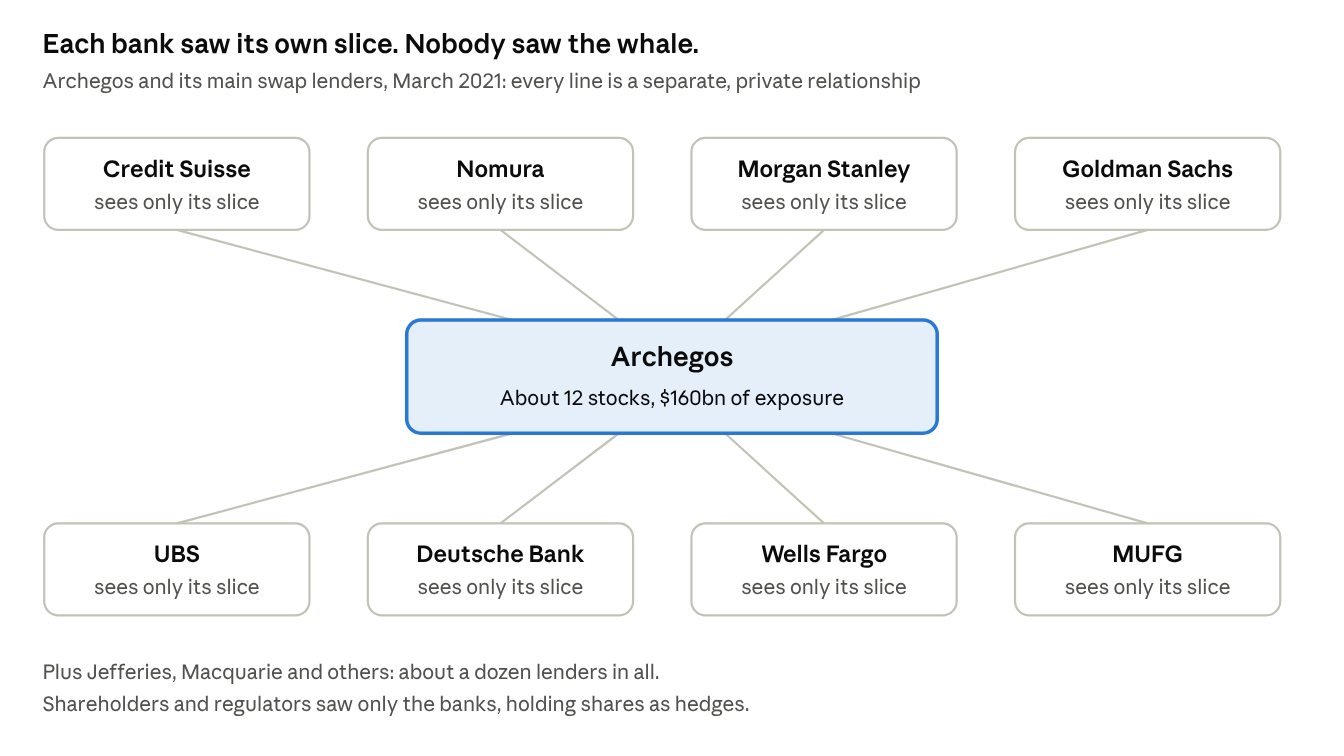
Archegos's main prime brokers · 8 shown of about a dozen lenders
Every bank had a direct line to Archegos. No bank had a line to any other bank. That missing line is the whole story.
Trust me, bro: what the banks were told
So why didn't the banks just ask? They did. Archegos lied.
Let's play a quick game. Here are things banks heard from Archegos. Guess: truth, or Archegos?
"No single position is more than 35% of our capital."
"Our portfolio is mostly liquid megacap tech, think Apple and Amazon."
"Our Viacom and GSX trades are unique to your bank."
"Our core stocks trade $2 to $3 billion a day, so we can exit easily."
Scroll down for the answers.
Answers: all four were false.
Line 1 (the 35% rule): Risk chief Scott Becker testified that CFO Patrick Halligan taught him never to admit any position was over 35% of equity. In reality, Viacom at one point equalled 96% of Archegos's capital.
Lines 2 and 3 (Apple, Amazon, "unique to you"): That's what UBS was told. Fairbanks said UBS would have refused Archegos's request had it known 67% of the portfolio sat in one stock.
Line 4 ($2 to $3 billion a day): Hwang said this to the banks on the final Thursday-night call. Tomita later told the jury those numbers were nowhere near reality.
When the charges came, the US Attorney summed it up in four words: "They lied, a lot."
But here's the uncomfortable bit. The lies only worked because the banks accepted them. Bloomberg, reconstructing the trial evidence, said bankers handed out billions based on little more than pinky promises about the portfolio's size and shape. Fairbanks himself admitted that clients being cagey about their holdings was normal.
In other words, the system ran on vibes. Each bank checked its own slice, nodded at the rest, and moved on.
Think about it. Remember your one condition from earlier? If it was "tell me what you hold at other banks," you'd have been lied to. If it was "I'll set my margin as if you're lying," you're starting to think like the banks that survived.
Credit Suisse: the smoke alarm that beeped for a year
Other banks were fooled. Credit Suisse is different. Its own alarms were going off for a full year, and it kept hitting snooze.
We know this because the bank paid law firm Paul Weiss to investigate itself. The 165-page report reads like a horror movie where you keep yelling at the screen. Let's watch it together.
Game: count the red flags. Keep a tally as you read. My count is at the bottom.
Spring 2020. Archegos has a "potential exposure" limit of $20 million (think: the maximum the bank is comfortable losing). By April, its exposure is more than ten times that.
July 2020. In a stress scenario, Archegos could cost the bank over $600 million. Soon it's $828 million, 330% of its limit.
September 2020. A risk committee discusses Archegos. It sets no deadline to fix anything. Not even a date to check back in.
October 2020. Instead of cutting risk, the bank grants Archegos a temporary $900 million increase in risk appetite.
Along the way. Archegos says rivals offer better terms, so the bank cuts its margin to 7.5%. In plain English, Credit Suisse lends $92.50 for every $7.50 Archegos puts down.
December 2020. Dynamic margining (collateral that rises automatically as a position gets riskier) is the obvious fix. Archegos isn't even on the list of clients to move onto it.
The $150,000 fix. A system upgrade that would have helped cost about $150,000. Nobody prioritised or funded it. Remember that number.
January 2021. The bank downgrades Archegos's credit rating from BB- to B+. In the same breath, risk managers recommend raising its limit from $20 million to $50 million. That's like lowering someone's credit score and doubling their card limit.
The clue. Credit Suisse learns that other banks charge Archegos higher margins and margin it dynamically. It also has non-public information that Archegos holds the same names elsewhere. The report says this should have sounded alarm bells.
February 23 to 24, 2021. The bank finally sends Archegos a dynamic margining proposal. Archegos ignores it.
March 4. The analyst follows up. Archegos says it hasn't had a chance to look yet. The financial equivalent of leaving someone on read.
March 8. The committee decides: move Archegos to dynamic margining. Archegos keeps dodging.
March 11 to 19. While the proposal sits ignored, Credit Suisse pays Archegos $2.4 billion in margin. On March 12, it also renews $13 billion of positions for two more years.
By the end, Archegos's gross exposure at Credit Suisse was $21 billion. The next biggest client in that business? $1.5 billion. One client was fourteen times bigger than the runner-up, and that client was rated B+.
And here's the line that makes this post's whole point. Credit Suisse's investment-bank CEO and its group chief risk officer first heard about Archegos on the evening of March 24, 2021. That's about 36 hours before the end.
The eyes were open. The alarms were loud. The signal just never travelled from the eye to the brain.
My count: at least 13 red flags, one per bullet. What was yours?
The week it all came apart
Pull up a chair. All times are New York time. Much of this comes from tapes, chats and emails shown at Hwang's trial.
Here's the shape of the week before we live through it. This was Archegos's single biggest bet.
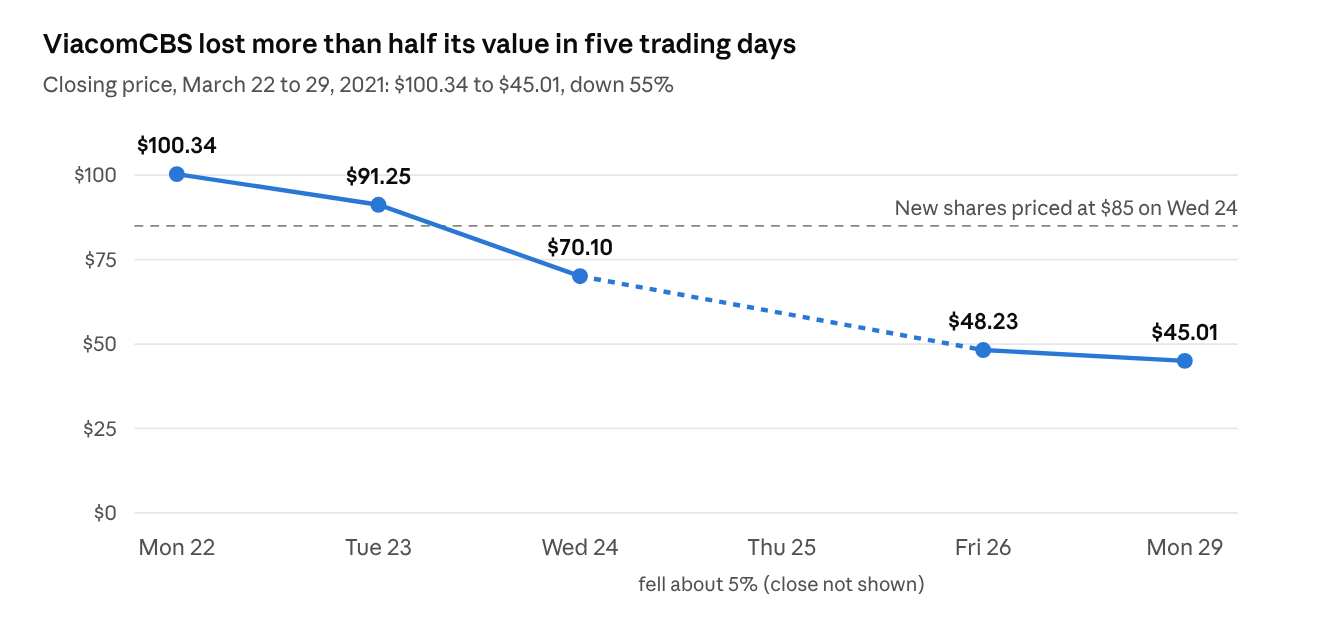
ViacomCBS closing prices reported by Variety, Next TV and FXStreet, March 2021 · Thursday's exact close not reported in these sources
The grey dashed line is the $85 price of Viacom's new shares. Once the stock fell below it, every buyer of the offering was underwater, and every bank holding Viacom as collateral started to sweat.
Monday, March 22: the match
ViacomCBS closes at a record $100.34, up 174% for the year. After the bell, Viacom announces a $3 billion share sale to fund its streaming push.
From Viacom's side, it's smart: your stock is at a record, so sell some. Viacom has no idea that the reason its stock is so high is one man in Manhattan.
Tuesday, March 23: the first crack
Viacom falls 9% to $91.25. Hwang throws another $900 million at the stock to hold the price up. It doesn't work.
Wednesday, March 24: the scramble
Viacom prices its new shares at $85 and drops 23% to $70.10. Inside Archegos, it's chaos with a calendar invite.
7:28 AM. Archegos is facing $2.5 billion in margin calls. The CFO jokes in chat that he was up all night with alarms going off and a Lionel Richie song in his head.
8:52 AM. The risk chief tells operations to hold off on anything payment-related. Delay, delay, delay.
10:30 AM. The SEC releases a proposal that hits some of Archegos's favourite Chinese stocks. Great timing, universe.
Midday. A junior staffer is supposed to withdraw $470 million from Goldman. Instead, the wire goes the other way: $470 million to Goldman. Goldman doesn't send it back. Hold that thought for later.
3:15 PM. UBS approves Archegos pulling out $173 million, even though a big margin call is due tomorrow. Its risk manager is suspicious, but says yes.
6:00 PM. Archegos is robbing Peter to pay Paul across a dozen banks. A wire arrives at 5:59 PM to pay Morgan Stanley by its 6:00 PM deadline. Becker's verdict in chat: insanity.
7:00 PM. The portfolio has fallen 48% today. On Zoom, Hwang gives staff three lines for the banks: we're a family office, we have no outside clients, our stocks are household names.
Evening. Becker later testified Archegos had $1.7 billion in spare cash, against margin calls expected to be $13 billion bigger the next day. In three days, its capital has gone from $36.2 billion to $16.9 billion.
9:57 PM. Co-CEO Andy Mills calls UBS to warn it won't meet tomorrow's call. His pitch: this is "a liquidity issue, not a solvency issue."
Same evening, at Credit Suisse. The investment-bank CEO and the chief risk officer hear the name "Archegos" for the first time.
Thursday, March 25: the day the eyes connect
6:43 AM. The call from our opening. Tomita admits the same stocks sit at multiple banks. Fairbanks's gut sinks.
Morning. Credit Suisse sends two margin calls totalling over $2.8 billion.
11:44 AM. A contact at Japan's MUFG wishes Archegos good luck and says it's no big deal. The CFO jokes MUFG deserves a best-counterparty award. (MUFG would lose about $270 million.)
12:30 PM. Archegos tells Credit Suisse it won't pay. Its cash has gone on other banks' margin calls.
1:01 PM. UBS tells Tomita that two board members are now personally involved and expect the call met today.
3:19 PM. A junior Archegos staffer messages colleagues that it's going to be a bloodbath, and that he's proud to fight alongside them.
About 8:20 PM. The big call. Credit Suisse, Deutsche Bank, Goldman Sachs, Morgan Stanley, Nomura and UBS are on the line, and Hwang finally speaks.
He admits he runs a very concentrated book of about 12 names. He sounds calm, says he's confident he can wind it down if they give him a little more time.
Archegos asks the banks for a standstill: nobody declares a default while it sells. The banks decline. Nomura suggests everyone sign NDAs so they can finally see the portfolio.
Sit with that one for a second. A room full of the world's biggest banks, asking for permission to see what they had been financing all along.
Meanwhile, the co-president is joining the call from an airport security line in Dallas, trying to catch the last flight to New York. And late that night, Morgan Stanley quietly sells about $5 billion of Archegos-linked stock to a small group of hedge funds.
Some of those buyers later felt betrayed, because nobody told them why the shares were for sale.
Pause and pick a side. It's Thursday, 11 PM. You're one of the six banks. Do you (a) honour the spirit of the call and wait, or (b) sell before anyone else wakes up? Write your answer down before you scroll. Friday will tell you who chose what.
Friday: the stampede
Here's the dilemma every bank woke up with.
All the banks are holding the same stocks as collateral. If everyone sells slowly and together, prices fall gently and everyone loses a bit. But if one bank sells first, it gets the good prices. Everyone who waits sells into a collapsing market.
Game theorists call this the prisoner's dilemma. Wall Street calls it Friday.
6:47 AM. Default notices start landing at Archegos. Game over, legally speaking.
7:50 AM. Credit Suisse begins unwinding, carefully, with a $1.25 billion block. One of its traders learns about the crisis by text on his day off. He grabs a Citi Bike and pedals to the office. His orders: sell slowly, avoid panic.
Before the opening bell. Goldman pitches a $3.6 billion block sale and quickly bumps it to $6.6 billion. The biggest single block is 20 million Baidu shares, about $3.7 billion. By day's end, Goldman has sold $10.5 billion.
Through the day. Morgan Stanley sells about $8 billion in blocks, on top of Thursday night's quiet sale. Deutsche Bank sells about $4 billion in a private deal, including to the hedge fund Marshall Wace.
1:30 PM. Jefferies reaches its CEO, Rich Handler, on holiday in Turks and Caicos with a spicy margarita on the way. His instruction, roughly: get the cocktail, then have the positions gone and a loss tally ready when I'm back. Jefferies escaped with minimal losses.
Afternoon. Analysts scramble to explain Viacom's crash with fundamentals. Hardly anyone realises it's one portfolio being dumped.
Close. Viacom falls 27% to $48.23.
4:00 PM. Archegos is wiped out. Just one week earlier, Hwang had gathered staff and talked about growing the fund to $100 billion.
8:12 PM. Staff are called onto Zoom. The firm has collapsed and is shutting down.
So who picked option (b)? Goldman, Morgan Stanley and Deutsche Bank sold fast. Credit Suisse and Nomura were the ones still trying to be orderly.
My take: in a run, polite loses. Credit Suisse wasn't wrong that a calm wind-down would hurt everyone less. It was wrong to assume everyone else would play along, after a year of not reading its own alarms.
The aftershocks rolled on all weekend. On Sunday, a $2.1 billion block of Viacom was sold at $47 a share. On Monday, Credit Suisse shares fell 14% and Nomura's 16%. Viacom closed at $45.01, less than half its price a week earlier.
The scoreboard: same client, same week, wildly different endings
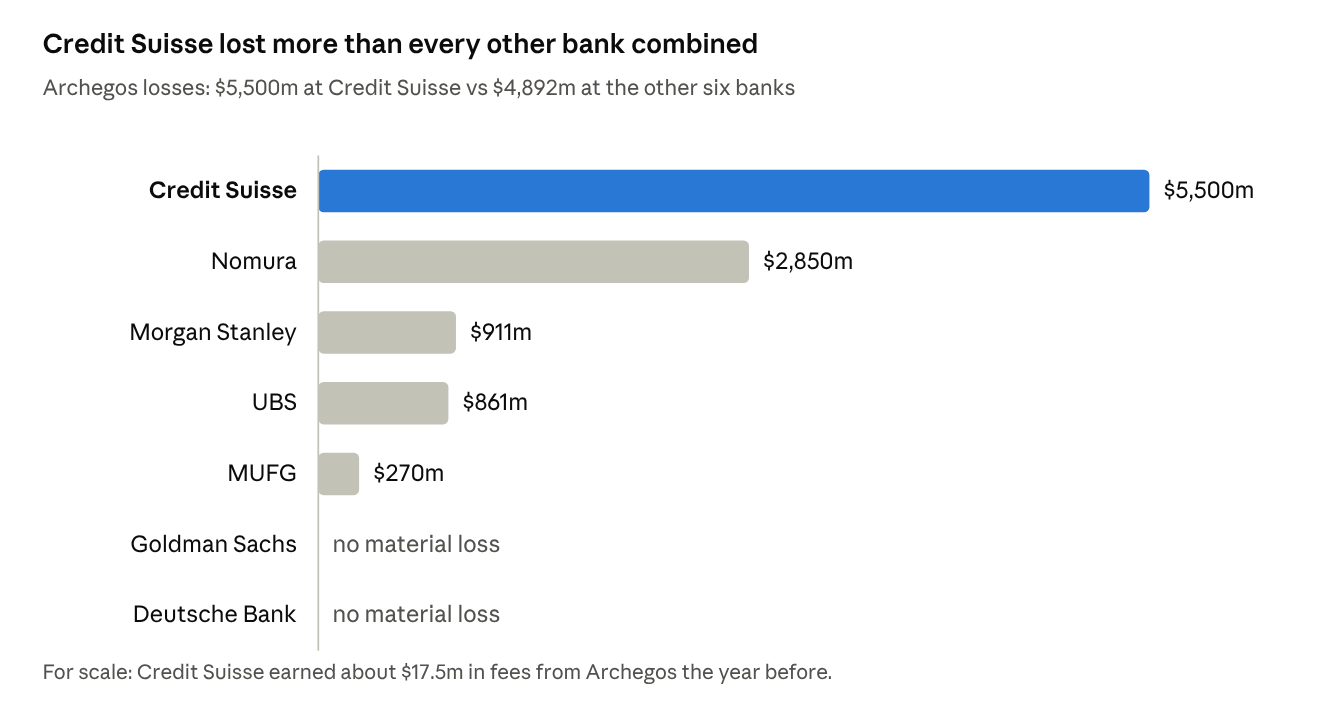
Bank disclosures, March to July 2021 · UBS includes its $87m second-quarter add-on; MUFG is its final figure
Do the maths on Credit Suisse. It earned about $17.5 million in fees from Archegos the year before, then lost about $5.5 billion. That's roughly 314 times what the relationship paid. No business on earth is worth that trade.
A few twists hiding behind those bars:
Goldman was fast, and a little lucky. It moved first on Friday. It was also sitting on that $470 million Archegos wired over by mistake on Wednesday. Bloomberg's verdict: Goldman's clean escape involved some luck as well as diligence.
Morgan Stanley sold first and still lost $911 million. Part of the reason: it was also an underwriter on Viacom's share sale, which made it slower to dump some Viacom stock. Its CFO later said Archegos may have misled the bank.
Deutsche Bank didn't just survive. It returned excess collateral to Archegos. It then posted its best quarter in seven years.
The vibes were different, too. At trial, Becker described Credit Suisse's tone during the crisis as "very soft," while Morgan Stanley came across as harsh and angry.
Same client. Same stocks. Same week. Some banks acted on a fragment of the picture. Others waited for the whole picture, and got it on Friday, in the form of a bill.
The reckoning
The crash took a week. The fallout took five years, and it isn't fully over.
For Credit Suisse, Archegos was the beginning of the end.
April 2021. Its head of investment banking and its chief risk officer leave.
July 29, 2021. It publishes the Paul Weiss report. It finds no fraud, just a failure to manage risk, escalate it, or act on breached limits.
November 2021. It shuts its prime brokerage business, the unit that served Archegos.
March 19, 2023. UBS, its old Swiss rival, agrees to take it over. The deal closes on June 12, 2023. The UK regulator later said the Archegos losses had caused the bank significant financial and reputational damage.
July 2023. Regulators fine UBS for Credit Suisse's sins. The US Federal Reserve takes $268.5 million and says staff repeatedly escalated red flags to multiple levels of management. The UK's Prudential Regulation Authority takes £87 million, its largest fine ever, and says the bank failed to learn from similar past experiences.
That last line stings. A year earlier, Credit Suisse had lost about $200 million on another hedge fund client, Malachite. The movie had a trailer. Nobody watched it.
For the people at Archegos, it ended in court.
April 27, 2022. Hwang and Halligan are arrested. The SEC calls Archegos a $36 billion house of cards.
May 13, 2024. The trial begins. Tomita and Becker, who have pleaded guilty, are the star witnesses.
July 10, 2024. Hwang is convicted on 10 of 11 counts.
November 20, 2024. Hwang is sentenced to 18 years and ordered to pay more than $9 billion in restitution. Prosecutors had asked for 21.
January 27, 2025. Halligan gets eight years.
2025. Becker and Tomita are both spared prison and get three years' probation. Tomita's judge said Hwang held an unusual sway over him and others at the firm.
March 2026. Hwang and Halligan are free on bail while they appeal. The SEC reports "very productive" talks to settle its civil case.
And for the system? Here's the plot twist.
After Archegos, the SEC proposed Rule 10B-1, requiring public reporting of large swap positions. It was, quite literally, a rule to give the market the one view none of the banks had: the whole whale.
On June 12, 2025, the SEC formally withdrew it, along with 13 other proposals.
Bloomberg's trial reconstruction offered a sobering thought. The lack of copycats since Archegos may say less about strict controls at banks, and more about how far one man was willing to push a system that let him.
A hundred eyes, zero insight
Time to check your answer from the top. Twelve banks watching one man: how many knew what he was doing?
Zero. Not until 6:43 AM on Thursday, March 25, when his own trader said it out loud. By then, the banks had roughly a day before the default notices went out.
In the myth, Argus fell because Hermes lulled his eyes shut. Wall Street's eyes never closed. They were wide open; they just weren't talking to each other. Archegos stacked three kinds of blindness on top of each other.
Built-in blindness. Swaps meant no bank, regulator or shareholder could see the whole position. Each bank saw only its own slice, by design.
Engineered blindness. When banks asked about the rest, Archegos lied. The 35% rule, the Apple-and-Amazon story, the "unique to you" line.
Chosen blindness. Credit Suisse didn't need anyone to tell it the truth. Its own alarms told it for a year. The signals reached the dashboard, never the decision.
The winners didn't have better data. Goldman, Deutsche Bank and Jefferies didn't see Hwang's full portfolio either. They acted on fragments. Nomura, meanwhile, was asking for NDAs to see the whole picture on Thursday night. Waiting for complete information is also a decision, and on Friday it was the most expensive one.
So what do you take from this into your own work?
Ask what everyone else's slice looks like. Your dashboard can be all green while the risk sits in someone else's spreadsheet. If you only measure your piece, you only know your piece.
An alarm that doesn't reach a decision-maker isn't an alarm. Credit Suisse had the data for a year. Its leadership heard the name 36 hours before the end.
When the downside dwarfs the upside, the upside is lying to you. $17.5 million in fees against $5.5 billion in losses. If a deal feels great, check what it can cost you.
Price in the lie. The banks that survived didn't trust the story more carefully. They set their terms as if it might be wrong.
Clarity beats completeness. You will rarely see the whole elephant. Insight is acting well on the part you can see, before the rest of it sits on you.
Having a hundred eyes was never the problem. Wall Street had more eyes on Bill Hwang than he had stocks in his portfolio. What it didn't have was anyone asking how the pictures fit together.
Over to you. Where in your job, startup or team are you watching a perfect dashboard while the whale swims somewhere else? Drop it in the comments. Bonus points if your answer involves a $150,000 fix someone decided wasn't worth funding.
Sources
Credit Suisse Special Committee report (Paul Weiss), SEC filing
Archegos: learning lessons from the past (Securities Finance Times)
Inside Archegos: why did risk management fail at Credit Suisse? (Rhizome)
'Worst Fear': Archegos witness recalls moment that doom appeared (Swissinfo/Bloomberg)
Morgan Stanley was angry as Archegos fell, witness says (Swissinfo/Bloomberg)
Hwang's spectacular collapse culminates in criminal charges (Al Jazeera/Bloomberg)
The rise and fall of Bill Hwang's house of cards (CNBC Africa/Reuters)
Morgan Stanley offloaded $5bn before the story broke (The Standard/CNBC)
Deutsche Bank dodged Archegos hit with quick sale (BNN Bloomberg)
PRA imposes record £87m fine on Credit Suisse (Bank of England)
UBS sanctioned for Credit Suisse's Archegos failures (Investment Executive)
Archegos head trader avoids prison (Crain Currency/Bloomberg)
SEC withdraws 14 proposed rules (Sullivan & Cromwell via CLS Blue Sky)